

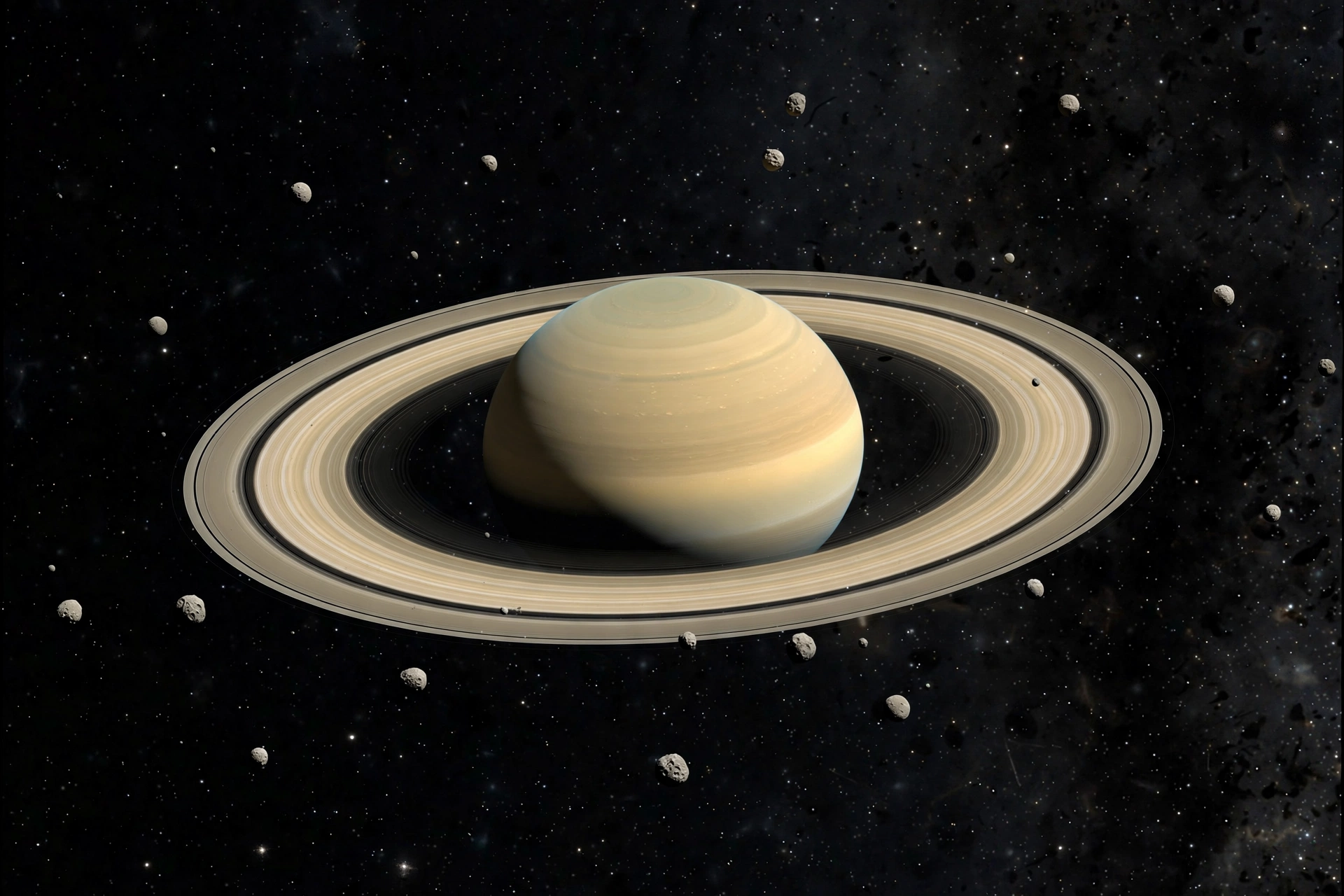
There is a simple pleasure in a record being smashed, and astronomy has just provided one. A survey team has confirmed 128 previously unrecognised moons of Saturn, pushing the planet’s total to 274. No other world in the solar system comes close. For readers who enjoy science explained plainly, this is a story about patience, powerful telescopes and tiny points of light that turned out to be entire worlds in orbit around a giant.
Finding faint worlds in archived images
Much of the work happened on computer screens rather than at the eyepiece. Survey images from the Canada-France-Hawaii Telescope, some gathered over several observing seasons, were reprocessed so faint moving objects stood out. Researchers at institutions including the University of British Columbia helped sift genuine moons from background noise, asteroids and image artefacts — a painstaking process in which most early candidates are eventually discarded as the evidence fails to hold up under scrutiny.
Families of moons with a shared past
Most of the newcomers are irregular moons: small, distant bodies on wide, tilted orbits, quite unlike Earth’s single large companion. Astronomers group many of them into families that share similar paths, which suggests they are fragments of larger moons shattered in collisions long ago. Every confirmed fragment is therefore a clue about Saturn’s violent past, and about how the environment around a young giant planet either builds moons up or grinds them down into swarms of rocky debris over billions of years.
The discovery also echoes themes in our recent articles, among them our coverage of research-driven change, where long-term effort eventually produced a headline few had predicted at the outset.
How a moon becomes official
A discovery only counts once it is recognised, and that recognition comes from the International Astronomical Union, which reviews the observations before adding a moon to the official lists. All 128 passed that test. The result leaves Saturn on 274 moons, well clear of Jupiter, whose tally sits far behind. Scientists involved in the survey have noted that Jupiter is unlikely to catch up soon, simply because Saturn’s population of small, faint moons appears to be so much larger than anyone expected.
There is also a lesson here about how modern astronomy actually works. The Canada-France-Hawaii Telescope did not find these moons by chance; its survey was designed to stare repeatedly at the region around Saturn so that moving objects could be separated from the fixed stars behind them. Researchers linked to the University of British Columbia were among those who turned that flood of images into confirmed orbits. The result is a catalogue that future missions, theorists and telescope planners will use for decades, because knowing exactly what circles Saturn — and on which paths — shapes everything from collision models to the design of any spacecraft that might one day tour the outer system in close detail.
Looking ahead to future surveys
The team expects more moons to surface as processing continues, because the survey’s detection limits suggest many smaller bodies remain hidden. Each one adds evidence about collisions, capture and the slow evolution of the outer solar system. Readers who followed our earlier science coverage will recognise the pattern: careful observation first, confident conclusions later. Saturn’s 274 moons are now the benchmark, and the planet’s rings suddenly look like only the second most remarkable thing about it.
For amateur astronomers, the news changes little in the eyepiece — these moons are far too faint for backyard telescopes — yet it deepens what a view of Saturn means. The bright globe and rings visible on a clear night are now known to sit at the centre of a swarm of at least 274 satellites, most of them invisible to us. Professional surveys will keep pushing the detection limit lower, and researchers openly expect the total to climb again. The solar system’s most familiar planet, it turns out, was keeping most of its family hidden in plain sight all along.
For readers keen to dig deeper, the University of British Columbia publishes research news on its teams’ work, and Nature offers continuing coverage of planetary science.
