

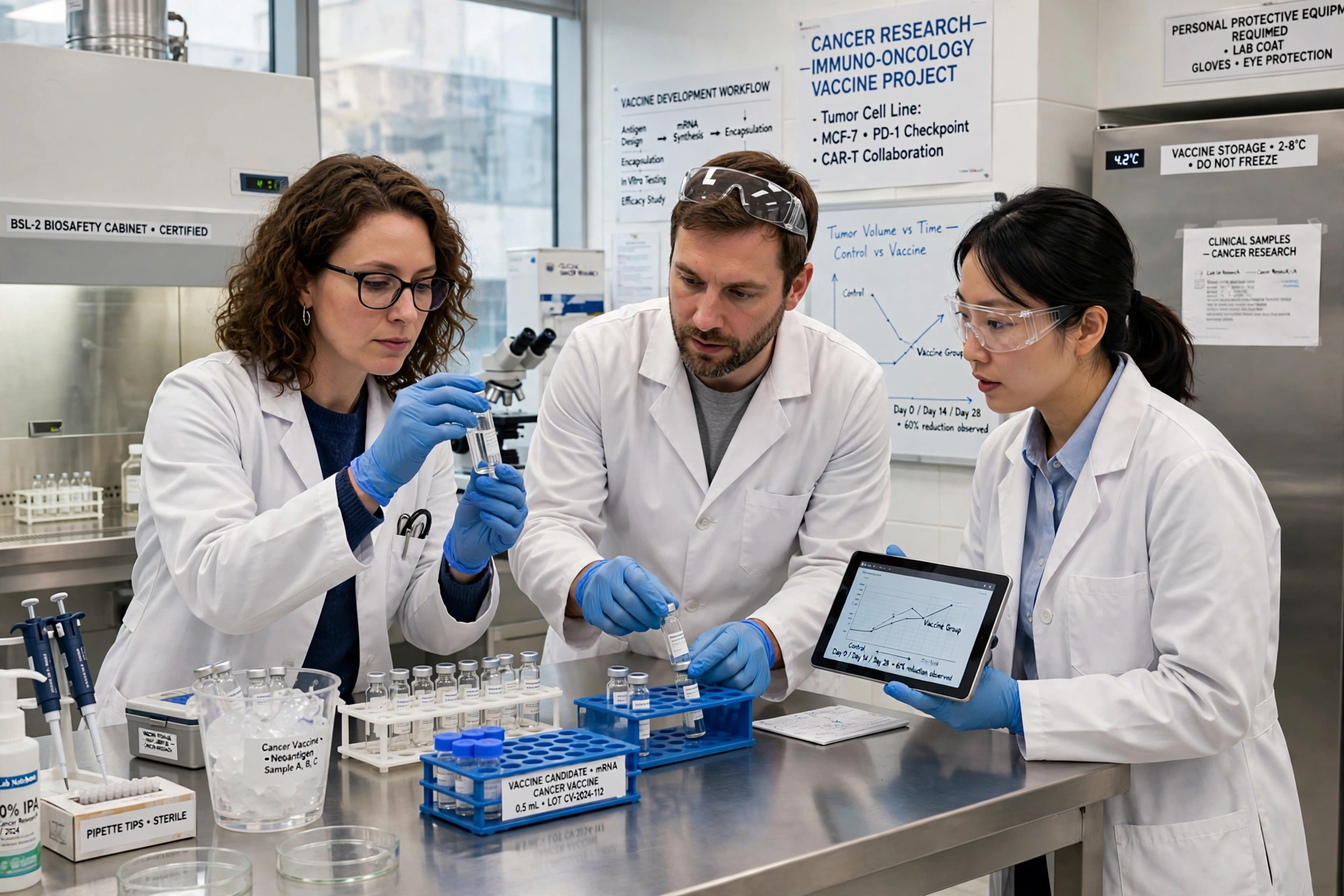
Scientists are testing whether a vaccine made uniquely for each patient can help the immune system fight ovarian cancer. In a phase 1 trial reported in Nature Medicine, researchers combined the personalised neoantigen vaccine NeoVax with nivolumab in people whose ovarian cancer was platinum-sensitive. The study found the approach feasible and its safety profile acceptable. Those are modest-sounding words, but in early cancer research they are exactly what a team needs to hear before bigger, definitive studies can be justified.
Neoantigens explained in plain terms
NeoVax belongs to a class of treatments built around neoantigens — abnormal protein fragments produced by mutations in a patient’s cancer cells and largely absent from healthy tissue. The process begins with sequencing tumour and normal DNA to find those mutations, then uses prediction tools to select targets the immune system is most likely to recognise. A vaccine containing those personalised targets is manufactured for that individual, aiming to teach immune cells to identify and attack cancer cells displaying the same markers.
What ‘feasible and acceptable’ really means
It helps to know what a phase 1 study can and cannot say. These trials recruit small numbers of patients and focus on feasibility and safety — can the vaccine be made in time, can it be given with nivolumab, and are adverse effects within acceptable bounds? The researchers report that the answer on each count was yes. Efficacy signals may be explored, but with small groups and no large comparison arm, any hint of benefit remains preliminary until randomised trials test the combination properly against standard care.
Regular readers will see the same measured approach in our other coverage, for example our recent article on an evolving health story, which likewise separated early promise from established fact.
Why researchers chose this patient group
There is a human reality behind the clinical terms. Ovarian cancer’s symptoms are vague, diagnosis often comes late, and even successful chemotherapy is frequently followed by relapse. Platinum-sensitive disease — cancer that responded to platinum drugs and remained controlled for a while — offers a window in which additional treatment might help. That window is where vaccine researchers are aiming, hoping an activated immune system can patrol for returning cancer cells long after chemotherapy has finished its work.
Feasibility deserves more attention than it usually gets in headlines. A personalised vaccine is useless if it arrives after the window for treatment has closed, so demonstrating that NeoVax could be designed, manufactured and administered alongside nivolumab, on schedule, is a substantive result. The trial population — patients with platinum-sensitive ovarian cancer — had already responded to chemotherapy, giving researchers a defined setting in which immune-based maintenance could be tested. Safety monitoring in such studies is intensive, covering injection reactions, immune-related side effects from nivolumab and the general tolerability of the regimen over repeated doses, all of which fed into the authors’ conclusion that the profile was acceptable.
Next steps for the research team
The next stage would be larger trials that can test whether the combination genuinely delays recurrence or improves survival, with patients randomly assigned so results can be trusted. Manufacturing speed and cost also matter: a vaccine made for one person must be produced quickly enough, and eventually affordably enough, to be practical beyond specialist centres. For now, specialists describe the Nature Medicine report as a solid foundation. Readers following our earlier health reporting will recognise the pattern — promising early steps, followed by the long, necessary work of proof.
Cost and access will eventually join safety and efficacy on the agenda. A vaccine manufactured for a single patient will never be cheap, and health systems will ask hard questions about value if larger trials succeed. Those debates are for later, though. The immediate significance of this study is narrower and, for researchers, genuinely valuable: a complex personalised regimen reached patients as intended, with an acceptable safety profile, in a cancer that urgently needs new ideas. That is how medical progress usually looks at this stage — unspectacular on the surface, essential underneath, and dependent on the bigger trials that must now follow.
The paper itself is published through the Nature portfolio in Nature Medicine, where related immunotherapy research is also regularly reported and reviewed.
